


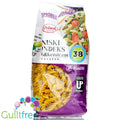
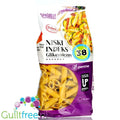
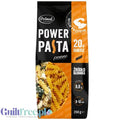
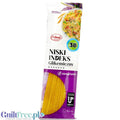
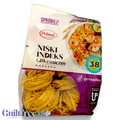

- Tested for Glycemic Index
- Unique composition
- Recipes created in cooperation with the University of Life Sciences in Lublin
- Meet the following health and nutrition claims:
- Low glycemic index carbohydrates help keep blood sugar levels stable
- High fiber content supports the proper functioning of the intestines
- High protein content supports the feeling of satiety - High content of the most valuable nutrients and minerals
Why does cooked pasta have fewer calories* than dry pasta?
Pasta in its dry form has a much higher energy density than when cooked. This is due to the fact that it absorbs water during cooking, so its weight increases, but the amount of calories and macronutrients remains the same. This means that there are fewer calories, fats, proteins and carbohydrates in 100 g of cooked pasta than in 100 g of dry pasta, since much of this mass comes from water.
By comparison, 100 g of dry pasta provides 357.6 kcal, while when cooked, in the same amount of weight, the value drops to 149 kcal. This is due to the fact that during the cooking process, pasta absorbs a large amount of water and increases its volume, making it less caloric per 100 g after cooking. The same goes for macronutrients - the amount of protein drops from 18.7 g to 7.8 g, carbohydrates from 48.0 g to 20.0 g, and fats from 6.7 g to 2.8 g.
If you cook, for example, 50 g of dry pasta, after cooking its weight will be about 100-120 g, depending on the degree of water absorption, but the caloric content will remain the same - about 178.8 kcal for 50 g of dry product. Therefore, per 100 g of cooked pasta, the energy value is lower, but the amount of calories consumed still depends on the portion size before cooking.
* There are fewer calories in 100g of cooked pasta compared to 100g of dry pasta.


